If you want to be awed on your next adventure, plan your trip around an animal migration. In these spectacular annual events, thousands and even millions of animals move from one place to the next to reach food or their breeding grounds.
It’s not always easy to witness a migration firsthand. Animals’ movements are influenced by the weather, ocean currents, and sometimes even the moon. Contact a local tour operator or conservation group to learn the best time to go in a particular year. Commit to practicing ethical wildlife tourism, so your presence doesn’t interrupt animals’ natural behaviors.
One last tip: Always, always get travel insurance. A plan with robust emergency medical benefits and emergency transportation benefits, such as OneTrip Prime, is a must when you’re visiting the world’s wild places. Planning your next trip? Get a quote.
Where to see the Great Migration in Africa
In July, the weather in the Serengeti—the vast wild plains in Tanzania—turns cool and dry. This sparks one of the world’s largest mammal migrations. Millions of wildebeest, as well as hundreds of thousands of zebra and gazelles, follow the rains north to the Masai Mara in Kenya.
“The journey is beset with danger,” Asilia Africa explains. “Young calves are snatched by predators, the slow are brought down by prides of lion, brave beasts break legs on steep river slopes, crocodiles take their share of the stragglers, and the weak and exhausted drown.”1
Tourism poses another threat to the migrating animals. A wildlife photographer released images of what he said was “the most shocking behavior I’ve ever seen”: hundreds of tourists and safari vehicles blocking river crossings, causing wildebeest to panic and injure themselves.
How can you experience the Great Migration in an ethical, sustainable way?
- Avoid the high season: The animals migrate year-round. See calves born in January through March, watch them cross a less crowded river in June and July, or witness the southern migration October through December.
- Visit a private wildlife reserve, which typically have tighter controls on vehicle numbers
- Choose a safari company that puts conservation first. Ask about their policies and rules.
- Speak up. Tell your guides that you want to respect the animals’ space and you don’t want to get too close.
Where to see the great bat migration
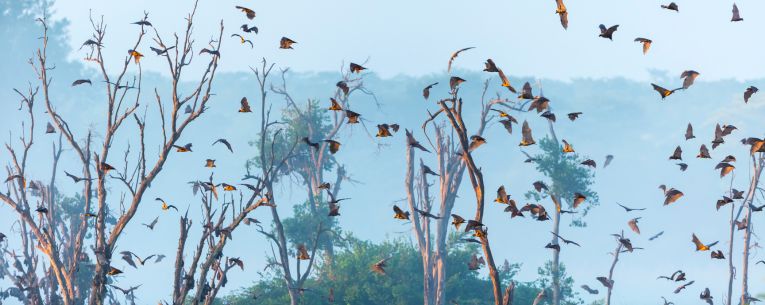
Most people are surprised to learn that the Great Migration isn’t the world’s largest mammal migration. That title is claimed by the straw-colored fruit bats of Zambia.
Millions of these bats fly from all over Zambia and neighboring nations to the swampy woods of Kasanka in central Zambia. During the days, they hang on the trees. Then at night, they fly out to feed on berries and other fruits, devouring 5 pounds per animal per day. They’re charismatic animals (if you like bats), with fox-like faces and a 2-foot wingspan.
The bat migration typically begins in October. They leave the park in January. The best way to see these creatures is on a guided tour, which will take you to a bat hide (a viewing platform high in the trees) in the evening or just before dawn.2
Where to see migrating monarch butterflies
“How do millions of monarchs start their southbound journey from all over eastern and central North America and end up in a very small area in the mountains of central Mexico?” asks the Monarch Joint Venture.3 The answer: We don’t really know. It seems impossible that these fragile creatures could fly for thousands of miles—and that’s what makes it one of the most amazing animal migrations.
The monarch butterfly migration is even more fascinating because it involves multiple generations of insects. Every year, the last monarch butterflies to be born in the eastern U.S. begin to flutter south toward their winter home in central Mexico. After a months-long journey, they gather in oyamel fir trees on south-southwest facing mountain slopes. The monarchs resume their migration in March, flying south toward Texas and other southern states. There, they reproduce, and their children continue the northward journey.
Where’s the best place to see migrating monarchs? The number one spot is the UNESCO World Heritage Site Monarch Butterfly Biosphere Reserve (La Reserva de la Biosfera Mariposa Monarca) in Michoacán, about 60 miles northwest of Mexico City. Do check the U.S. Department of State’s most current travel advisories for Mexico, as Michoacán is known for high levels of violent crime.
You can also see migrating monarchs in the United States, although not in the dense concentrations you’ll see in Mexico. Prime monarch-viewing spots include the Eastern Shore of Virginia National Wildlife Refuge in September and October, where researchers count and tag the butterflies, and St. Marks National Wildlife Refuge in Florida, which is their last refueling stop before they fly over the open water of the Gulf of Mexico.4
Where to see migrating whale sharks
Whale sharks are the world’s largest fish: enormous and peaceful filter-feeders that migrate long distances. One female whale shark was tracked migrating from the eastern Pacific to the western Indo-Pacific, a journey of more than 12,000 miles.5
Whale sharks’ epic migrations mean you can see them—and in some cases, swim with them—in many places in the world. Some of the best places to see whale sharks:
- La Paz, Mexico (October-April)
- Coiba National Park, Panama (January-April)
- Donsol Bay, Philippines (January-May)
- Gladden Spit, Belize (March-May)
- The Caribbean, including Cancun, Cozumel, and Turks & Caicos (June-September)
- Koh Tao, Thailand (March-May, September-October)6
Unlike wildebeest, whale sharks are solitary animals. You probably won’t see hundreds of them, but sighting even one will be an experience you’ll never forget. PADI, the scuba diving organization, offers some advice on diving or snorkeling with whale sharks without frightening them. Enter the water quietly, and minimize splashing. Don’t chase or touch the shark. And don’t get too close—it’s good to stay at least 9 feet away from the head and 13 feet from the tail.
Where to see the red crab migration
When you think of majestic animal migrations, you probably don’t think of crabs. But the annual movement of tens of millions of crabs across Christmas Island is an unforgettable sight—one that famous naturalist Sir David Attenborough even called one of his greatest TV moments.
The migration on this island in the Indian Ocean begins with the first rainfall of the wet season (usually in October or November, but sometimes later). All over the island, land-dwelling red crabs march toward the ocean to mate. A few weeks later, the females spawn, releasing fertilized eggs into the sea.
This ritual is precisely scheduled: Red crabs always spawn before dawn on a receding high tide during the last quarter of the moon. “Incredibly, they know exactly when to leave their burrows to make this lunar date,” says Christmas Island National Park.7
The red crab migration is hard to miss. Crabs are everywhere, crawling into people’s houses and crossing roads on special crab bridges. To see them, you may want to book a tour in advance that includes a naturalist guide. The exact dates will change depending on the crabs, however, so it’s best to keep your schedule open.
Related Articles






Share this Page